For over two decades, VIVID Emerging Designer Awards has been an engine behind some of the brightest new talents in the country, taking their work directly to the biggest names in the design industry. 2026 will mark the 23rd year of Australia’s longest running competition for emerging designers, taking place during Decor + Design, 15 -17 July at Melbourne Exhibition Centre. Register here to be notified when entries open on 19 February.
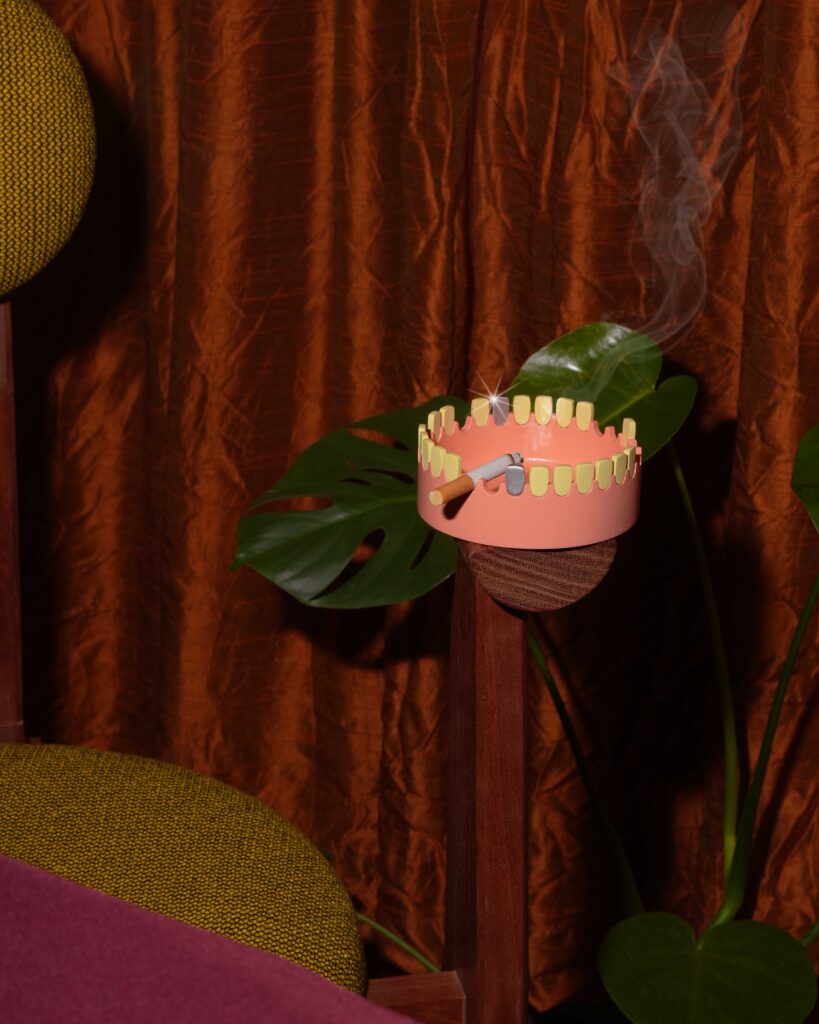
Frankly, we’re still buzzing from the 2025 edition! The gorgeous VIVID installation drew a perpetual crowd during the show and one designer in particular left her mark. The prestigious ‘Judges’ Choice Award’ was presented to talented designer Maryam Moghadam for her thought-provoking piece Gnawing [Knowing]. Pictured above and below, this explorative piece questions the inner tension of humanity through the acts we choose.
 We spoke to Maryam (left) to understand her journey and the inquisitiveness and play that inspires her work. This interview is essential for any emerging designer – read on!
Maryam, can you tell us about your journey into the design world?
My journey into design started with drawing. As a child, drawitng was my love, and I was always experimenting with different styles rather than excelling at any one of them. I wanted to be an artist, but the idea of the “starving artist” wasn’t especially reassuring to my dad. When it came time to choose a university path, industrial design felt like a sensible middle ground – a way to stay creative while offering security.
It wasn’t until after graduating that I really appreciated that decision. Design gave me a framework and a discipline that my natural way of working lacked. My instincts are intuitive, messy, and often chaotic, and studying design taught me how to discipline that expression rather than suppress it. It also taught me how to make things – from digital tools such as 3D printing and laser-cutting, to working in the workshop with traditional fabrication processes. It gave me a deeper understanding of materials, production and how ideas move from concept to physical form.
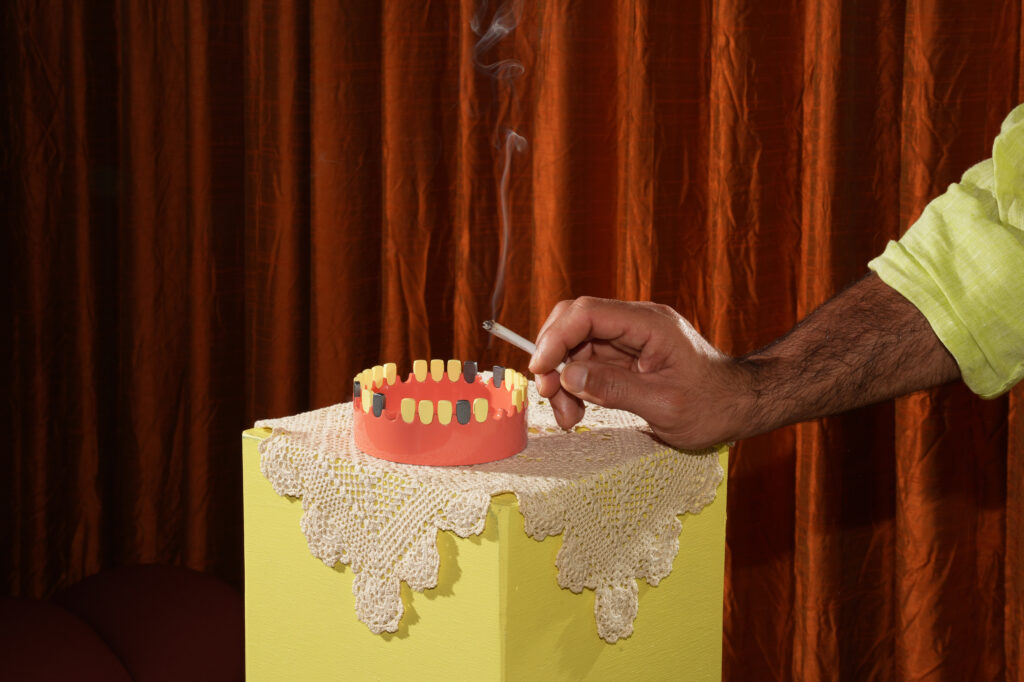
Gnawing [Knowing]. Image: Maryam Moghadam
What inspired the concept behind Gnawing [Knowing]? Is there a personal story or experience that influenced this design?
My work is always a reflection of my inner world. I see myself as an artist first within the narrative of my designs, so Gnawing [Knowing] is very much a personal work – in an observational, not confessional, sense.
The piece emerged from my interest in the coexistence of “the animal” and “the intellectual” within us. The part of us governed by instinct, impulse, and the nervous system (expressed via functional ashtray, which encourages smoking) – and the part that is capable of reflection, foresight, and self-analysis (expressed via ashtray message, which discourages smoking). Addiction sits in that tension. We are often fully aware of the harm yet still compelled toward the behaviour.
Gnawing speaks to that compulsive, erosive drive – a chewing away that we return to and causes incremental harm – while Knowing refers to the parallel presence of awareness. The design isn’t interested in moralising or correcting behaviour. It simply reveals a truth about human nature: that knowledge does not automatically liberate us from instinct.
At the time of creating the piece, I was in a period of recognising and analysing my own self-destructive patterns. The work came from that moment of clarity – recognition, not resolution. Where I am now is less about indulgence or denial, and more about reconciliation: finding ways for the animal and the intellectual to coexist productively rather than destructively.
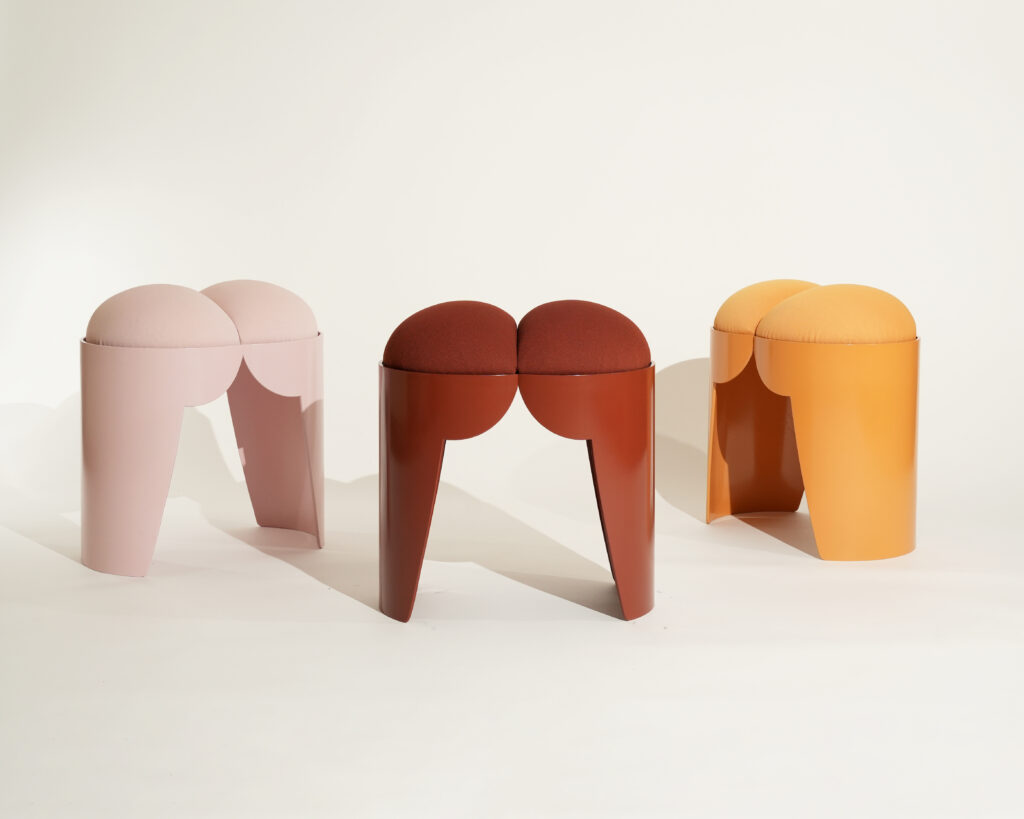
Cheeky Stools by Maryam Moghadam
How does your design challenge traditional ideas or push boundaries?
First, the work is narrative-driven rather than function-led. We’re usually taught that form follows function, but in this piece, the story comes first. The anatomy of the teeth sets that up, and the function grows out of it rather than being designed separately.
The mouth already has a cup-like arrangement – it holds and contains things – so the ashtray function is almost already there. The missing tooth reads first as decay, and only later as the place where you rest the cigarette. In that sense, the ergonomics feel almost accidental, and that’s intentional. The function settles in quietly without getting in the way of the narrative.
Another way the piece pushes boundaries is in how it sits within high-end design. Literal or illustrative forms are often dismissed as kitsch or novelty-driven in that space. I come from a strong illustrative instinct which I’ve tried to discipline through design. The challenge is in knowing what to remove – paring back detail while leaving just enough to communicate the form clearly. That restraint is what allows the piece to feel considered rather than decorative.
Finally, the object insists that narrative and function don’t have to compete. It invites thought, but it doesn’t demand it. If someone doesn’t want to engage with the idea at all, it still works perfectly well as an ashtray. It’s a space where artistic expression and design discipline carry equal weight, which is the kind of work I’d like to produce.
What message or emotion do you hope people take away from Gnawing [Knowing]?
Some people read the work as an attempt to discourage smoking; some people snicker at the cartoonish depiction of the body; others experience discomfort seeing something confronting applied to an object that’s conventionally expected to be refined or decorative. I welcome these responses. My ultimate hope, however, is that the object produces a moment of self-awareness and reflection; a recognition of universal human psychology and behaviour that will above all foster empathy, for both the self and for others.
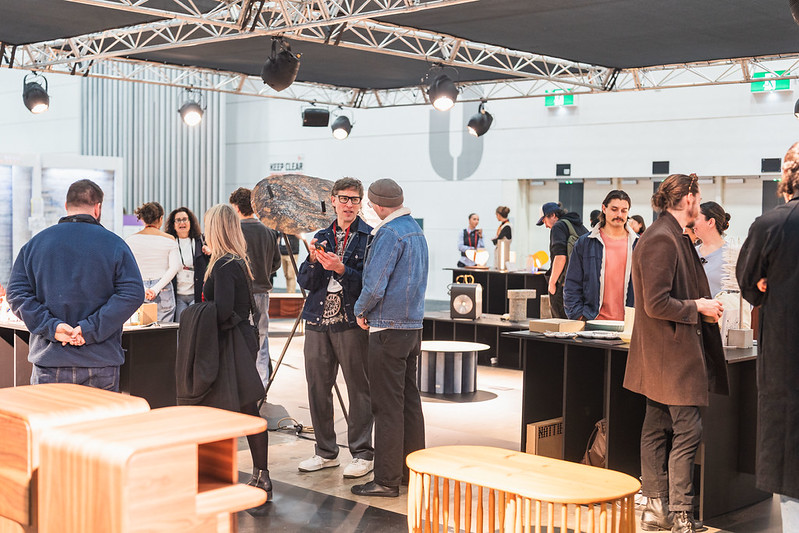
VIVID Emerging Designer Awards at Decor + Design
Winning the Judges’ Choice award at VIVID Emerging Designer Awards is a significant achievement. What does the award mean to you?
More than anything, the award feels like fuel. It affirms that I can put something deeply personal and honest into the world – something that reflects how I see things, even when it sits slightly off-centre – and have it recognised and resonated with. That is both invigorating and motivating. It encourages me to keep engaging with the creative process and to trust my instincts, which is when I feel the most present and alive.
Why is VIVID Emerging Designer Awards important to the industry?
Many people I spoke to described VIVID as the highlight of Decor + Design, signaling a strong appetite for new voices and fresh perspectives. Platforms like VIVID matter because they give emerging designers space to contribute meaningfully, not just stylistically, and help the industry stay responsive to where design thinking is heading.
Among my peers, there’s a clear drive toward ethical, considered work grounded in responsibility, quality, and care for both human wellbeing and the environment. VIVID creates a point of connection where the industry can recognise and engage with the values shaping the next generation of designers.
What’s next for you? Are there any upcoming projects or ideas you’re excited to explore?
I’m currently moving several works into production, including manufacturing the Cheeky stools with a Melbourne-based manufacturer and finalising Gnawing [Knowing] ashtray. I’m also developing a new piece that explores an oft misunderstood aspect of self-respect and self-protection, which I’m hoping to complete by the end of the year.
Intrigued? Explore Maryam’s work further on her website or on Instagram.
If you’re an emerging designer less than five years in practice or a design student, we’d love you to consider entering the 2026 VIVID Emerging Designer Awards, which will be judged by a panel of design industry heavyweights and curated by Latitude Group. Register your interest now to be notified when entries open.